











2 min read
Germany's fiber operators must streamline processes and enhance customer experiences to close the gap between network coverage and active subscriptions.
 Netadmin Content Creator

Europe's fiber buildout is, for most Western markets, effectively done. Networks now pass 76.8% of EU27+UK homes, according to FTTH Council Europe's 2026 Market Panorama. Yet only 42.1% of households are actually subscribed — a take-up rate of 54.9%. That gap is not a coverage problem. It is a commercial and operational one.
For mid-sized fiber operators, this shift in the competitive landscape changes what "good" looks like. The metrics that defined success during rollout — homes passed, activation speed, network reach — are no longer sufficient. The question now is how efficiently an operator can convert a home passed into a paying subscriber, and then keep that subscriber long enough to justify the infrastructure investment.
That requires a different kind of operational readiness. And for many operators who scaled quickly on Greenfield momentum, it exposes gaps that were easy to overlook when growth covered the cracks.
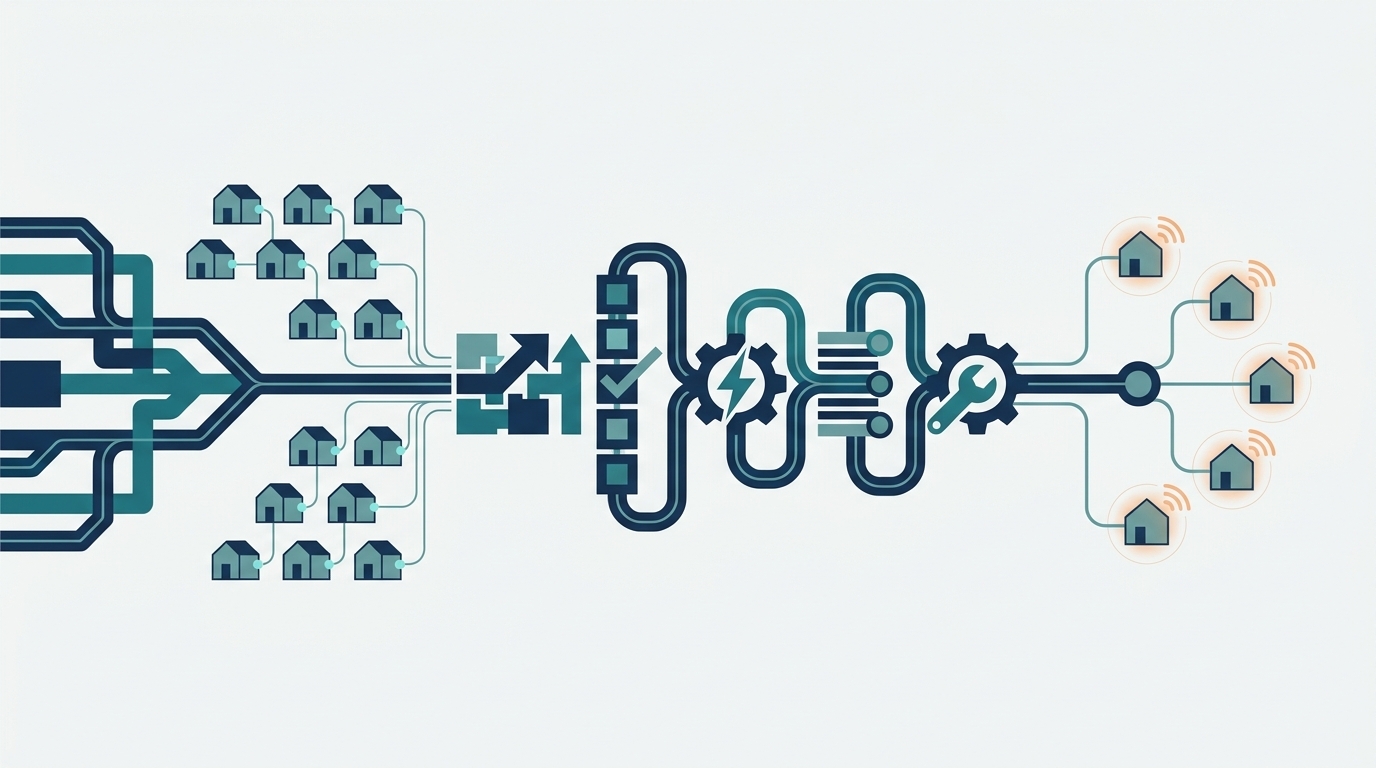
The Build Era Is Over. The Conversion Era Has Different Requirements.
Opensignal's analysis of 18 European markets reinforces what the FTTH Council data implies: infrastructure quality alone does not drive subscription. Networks that are technically excellent still face low take-up where the commercial and operational layers are not working in sync.
Converting a home passed into an active subscriber involves more moving parts than it might appear. Sales, provisioning, billing, and service assurance all need to be coordinated — and coordinated quickly. A customer who signs up and waits three days for activation, receives a confusing first invoice, or has to call support to resolve a service issue is a churn risk before they have ever become loyal.
Operators who ran lean during buildout — often relying on separate systems for billing, CRM, and network management — can find that these gaps compound at scale. What worked for 20,000 subscribers can create serious friction at 100,000.
Fragmented Platforms Create Operational Drag at Exactly the Wrong Time
The BSS capabilities that mattered least during rollout matter most now. Customer management, contract handling, billing accuracy, and service lifecycle visibility are the operational backbone of a conversion-focused business.
When those functions live in separate, poorly integrated systems, the cost shows up in slow order fulfilment, billing errors, and support overhead. It also shows up in churn — subscribers who leave not because the network is bad, but because the experience around it is inconsistent.
This is not a technology problem in the abstract. It is a process problem with a technology root cause. Operators in this position often know where the friction is; the harder question is how to address it without disrupting a business that is already running at pace.
Modern, integrated OSS/BSS platforms — those that coordinate the commercial and operational lifecycle from order and activation to invoice and service management — can reduce that friction. They give operators a cleaner picture of each subscriber relationship and faster execution across activation, billing, and service management. Netadmin Nine is built around this kind of end-to-end approach, which is increasingly relevant as the competitive focus shifts from coverage to retention.
Practical Conclusion: Operational Modernization Is Now a Commercial Priority
The operators who will perform best in the conversion era are not necessarily those with the best networks. They are the ones whose internal operations can support a consistent, low-friction subscriber experience at scale.
That means auditing the gaps now, before churn becomes a measurable problem.
What to do next:
-
Map the handoffs between sales, provisioning, billing, and support — identify where delays or errors are most common
-
Quantify how long activation currently takes from order to live service, and what causes variance
-
Review billing accuracy rates and support ticket categories — both are leading indicators of operational friction
-
Assess whether your current BSS gives you a single view of each subscriber's contract, service, and payment status
-
Evaluate what it would take to consolidate fragmented systems before subscriber volumes make integration more complex
The window to get ahead of this is open now. Most Western European markets have largely completed their fiber buildout. The operators that modernize their commercial and operational infrastructure in the next 12–24 months will be better positioned to capture and retain subscribers as competition for the same homes intensifies.
Ready to see how an integrated OSS/BSS platform supports conversion at scale? Book a demo with Netadmin.
Related links:
 For more information, please contact
Johan Hjalmarsson, Product Marketing Manager, Netadmin Systems.
Email: johan.hjalmarsson@netadminsystems.com