











4 min read
Germany's copper switch-off accelerates the shift to fiber, urging operators to modernize OSS/BSS for efficiency and compliance in a fragmented market.
 Netadmin Content Creator

Germany's fiber market is at an inflection point. The federal network regulator BNetzA is moving forward with copper switch-off rules that will force operators and end customers onto fiber infrastructure. At the same time, industry associations VATM and BREKO are pushing back on regulatory direction and terminal equipment rules. For mid-sized fiber operators in DACH — regional communication providers, Stadtwerke, and new altnets — this is not background noise. It is a map of the decisions that will define network investment, wholesale positioning, and operational readiness over the next 24 months.
The regulatory landscape in Germany is uniquely complex. BREKO, BUGLAS, and VATM represent operators with different business models and competing interests. Dozens of operators are building overlapping networks. And now, three regulatory developments are converging: copper migration timelines, terminal equipment disputes at the fiber network termination point, and growing anxiety about market fragmentation. Operators who treat this as a compliance exercise will find themselves behind. Those who use it as a forcing function for operational modernization will be better positioned.
Copper switch-off is not just a migration deadline — it is a forcing function for OSS readiness
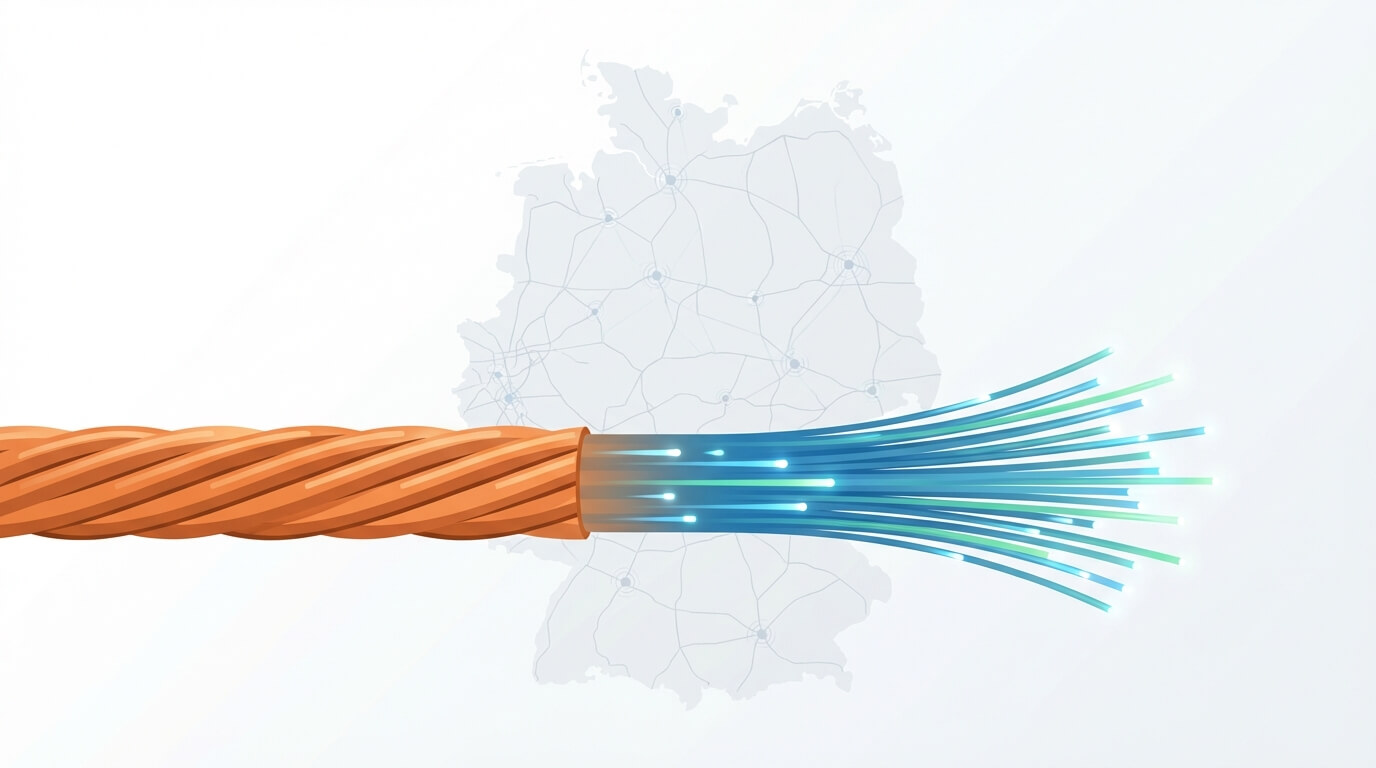
BNetzA's copper switch-off plans are designed to accelerate the migration from legacy infrastructure to fiber. For many operators, this creates a hard timeline for network modernization. The challenge is not just physical infrastructure. It is also the operational systems that manage provisioning, activation, and service delivery across mixed networks.
Operators still running copper services alongside fiber often manage them in separate systems. Copper provisioning workflows are manual or semi-automated. Fiber provisioning may be handled in a newer OSS/BSS platform, but integration with legacy systems is incomplete. The copper switch-off removes the option to defer integration. Once copper is no longer available, all services must run on fiber, and all provisioning must flow through a unified system.
This is where operational risk becomes visible. If your OSS cannot handle fiber provisioning at scale, migration deadlines expose capacity bottlenecks. If service activation requires manual intervention, customer onboarding slows down. If wholesale access terms are not built into your provisioning logic, you cannot respond quickly to regulatory changes or competitor pricing.
Operators who have already invested in purpose-built OSS/BSS platforms designed for European regulatory complexity are in a stronger position. Those who have delayed OSS modernization will face compressed timelines and higher risk.
The terminal equipment dispute is a proxy for wholesale access control
VATM and BREKO are contesting BNetzA's rules on terminal equipment at the fiber network termination point. On the surface, this is a technical dispute about who controls the customer-facing interface. In practice, it is a dispute about wholesale access, customer lock-in, and competitive positioning.
If BNetzA's rules favor one type of equipment or one operator's infrastructure, it affects how alternative operators design their service offerings. If terminal equipment rules create friction for wholesale customers, it reduces the attractiveness of open-access models. And if the rules are unclear or subject to change, operators face uncertainty in network design and customer contracts.
For mid-sized operators, the takeaway is not to wait for regulatory clarity. The takeaway is to build OSS/BSS platforms that can adapt to different wholesale models, support multiple terminal equipment configurations, and handle service provisioning under evolving regulatory frameworks. Flexibility is not a luxury. It is a requirement in a market where the rules are still being written.
Operators who hard-code wholesale logic into custom systems will struggle to adapt. Operators who use configurable platforms with rule-based provisioning engines can respond faster.
Market fragmentation means operational efficiency is the only defensible advantage
Germany's fiber market is fragmented. Multiple operators are building overlapping networks in the same regions. BREKO, BUGLAS, and VATM represent different operator groups with competing interests. And regulatory uncertainty makes it difficult to predict which business models will succeed.
In fragmented markets, operational efficiency becomes the primary competitive advantage. If two operators offer similar network coverage and similar pricing, the one with faster provisioning, lower operational costs, and better customer experience will win. This is not about technology for its own sake. It is about execution.
Operators with modern OSS/BSS platforms can provision services faster, reduce manual intervention, and scale without proportional increases in headcount. Operators with legacy systems or patchwork integrations spend more time on exceptions, manual corrections, and internal coordination. Over time, this creates a cost disadvantage that is difficult to reverse.
The regulatory uncertainty in Germany makes this more urgent, not less. If you cannot predict which wholesale models will be required, you need systems that can support multiple models without custom development. If you cannot predict how terminal equipment rules will evolve, you need provisioning workflows that can adapt without rewriting code. And if you cannot predict which competitors will enter your market, you need operational efficiency that allows you to compete on execution, not just on price.
What to do next
-
Assess your OSS/BSS readiness for copper switch-off timelines. Can your platform handle full fiber provisioning at scale, or will you hit capacity bottlenecks during migration?
-
Review your wholesale access logic. Is it hard-coded into custom systems, or can it be reconfigured as regulatory requirements change?
-
Identify manual intervention points in your provisioning workflows. Where does service activation require human input, and what would it take to automate those steps?
-
Evaluate terminal equipment compatibility. Can your OSS support multiple configurations, or are you locked into a single vendor's approach?
-
Map your competitive position against operational efficiency, not just network coverage. If a competitor with similar infrastructure can provision faster and operate leaner, how do you close that gap?
Germany's fiber regulatory landscape is not settling down. It is accelerating. The copper switch-off creates hard deadlines. The terminal equipment dispute affects how operators design customer-facing services. And market fragmentation means operational efficiency is the only defensible advantage. Operators who treat this as a compliance exercise will fall behind. Those who use it as a forcing function for OSS/BSS modernization will be better positioned to execute when the rules become clear.
Netadmin Systems builds OSS/BSS platforms for European fiber operators who need to operate in complex, evolving regulatory environments. If your platform cannot adapt to new wholesale models, provision at scale, or handle fragmented market conditions, it is time to reassess.
Ready to modernize your operations? Contact Netadmin to discuss how purpose-built OSS/BSS can support your fiber business in DACH and beyond.
Related links
BNetzA (German Federal Network Agency)
VATM (Association of Telecommunications and Value-Added Service Providers in Germany)
BREKO (Federal Association of Broadband Communication)
 For more information, please contact
Johan Hjalmarsson, Product Marketing Manager, Netadmin Systems.
Email: johan.hjalmarsson@netadminsystems.com